Getting a Violin
Violin Hardware (chinrest and shoulder rest/sponge options)
Suzuki Reference Recordings
Suzuki Book
Notebook
Helpful Books by Suzuki, Ed Sprunger
The wider Suzuki world: Play-ins, Workshops, Festivals, and Institutes
How do I get a violin?
In general, renting an instrument is the most flexible and affordable for beginners of any age and students needing fractional sizes. The highest-quality instrument you can access will be the best-sounding, easiest to play, and most motivating for the student to continue putting in the sometimes frustrating work of learning to play this beautiful and challenging instrument! I have experienced for myself how much a quality instrument can itself be a teacher, allowing better and more advanced technique to develop that translates “back” to a less responsive instrument. Johnson Strings in Massachusetts and Shar Music in Michigan both have good-quality rental instruments available through online/mail-order. I am currently investigating the local violin shops in Maine and what is available for quality rentals. When a student advances beyond the rental instruments available or grows to be able to play a full-size violin, purchasing an instrument and quality bow makes sense. Many shops offer trade-in credit for instruments previously purchased from them, and rental credit towards purchase. I’m happy to share more information about this when the time comes.
Violin Hardware
Much of our early work learning to hold the violin is all about setting up a comfortable, functional way to hold the violin that minimizes effort and leaves the hands free to move around on different strings, and later on, climbing up the fingerboard. Because every child’s neck and jaw are different, it is worthwhile to make sure the hardware (chinrest and shoulder rest) fits well and serves that goal of finding physical ease in playing.
Your violin, whether purchased or rented, almost certainly comes with a chinrest which is attached to the violin with a metal bracket. Many of my students prefer the more universal shape and height of chinrests made by Wittner. The side-mount chinrest works for many students; some have a taller neck and benefit from the center-mount chinrest, or side-mount with an additional piece of cork under it. You can buy them from Johnson’s, and I can help you find a used or hand-me-down from another student who has outgrown theirs:
Once the chinrest height and shape are comfortable, you’ll need something to comfortably and securely fill in the space between the back of the violin and the shoulder/upper chest. This is called a shoulder rest or sponge. There are many options here, but I recommend two for affordability and because they allow the shoulder to move a little more than a rigid plastic shoulder rest. These are structured foam sponges by PolyPad and Belvelin. (I myself use a Belvelin now after many years of a hard plastic or metal shoulder rest!) Also available from Johnson String, and I have some spare Belvelins you can try to see if they are comfortable:
| PolyPad (blue) | Belvelin (black) |
| 1/16–1/8 | 1/32–1/8 |
| 1/4 | 1/8–1/2 (or more, I use this one) |
| 1/2–3/4 | 3/4–4/4 |
| 4/4 (this one is huge, hard to fit in some cases) | minimal (not for beginners) |
Suzuki Reference Recordings
Part of learning violin in the Suzuki philosophy is creating a musical environment. Like your child heard people speaking all around them as they were learning their first language, we want them to hear music of all kinds. The Suzuki “official” reference recordings serve two purposes: to be an example of the beautiful sound that we want to strive for (played by one of the world’s top violin soloists), and to help students learn all their pieces by ear so they can hear the tune in their head, and sing it, before trying to produce it on their instrument. This means the learning-the-notes layer can be already done/solid before dealing with the physical stuff to actually make the sounds.
Alfred, the publisher of all the official Suzuki materials, is slowly catching up to how most people actually listen to music these days. Unfortunately they’re not available on music streaming services (Spotify, YouTube, etc.), probably because the artists get paid basically nothing for their work through those platforms.
If you still have a CD player, buy the book bundled with the CD and you’re good to go!
If not, all the digital ways to access the recordings are on Alfred’s website, including their own site that you can save to your device home screen as an “app” to access digital albums you buy: https://www.alfred.com/pages/suzuki-audio-downloads and click “violin”
Suzuki Book
Because we won’t be learning music by reading from a printed score at the beginning, the Suzuki book is a parent reference more than anything initially, and a place to put lesson stickers and track pieces as they are learned and polished. Available mail-order and at Buckdancer’s Choice in Portland (call ahead if you’re coming from far away). Make sure you get Suzuki Violin School Volume 1, International Edition.
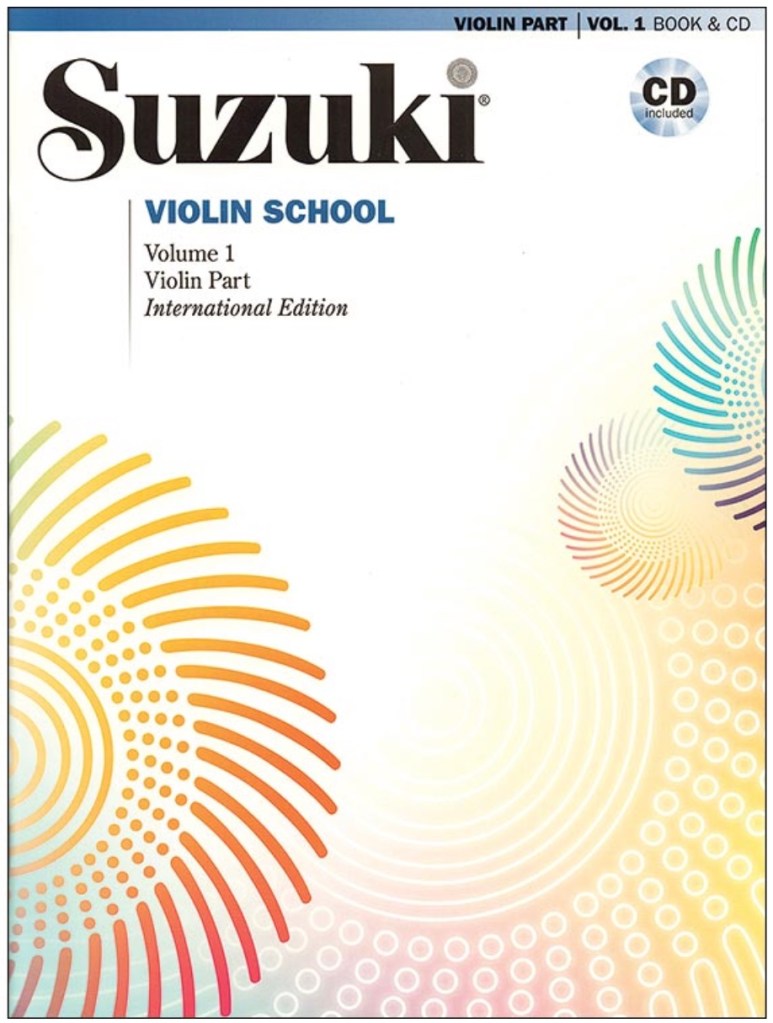
Johnson, no CD | Johnson, with CD
Notebook
Any kind of notebook for the home practice partner, and sometimes the student, to write down during the lesson what and how to practice at home.
Helpful Books by Suzuki, Ed Sprunger
Building Violin Skills | intimidating-looking but extremely helpful book for everything from the first parent lesson through readiness to play Twinkle, written by a master Suzuki teacher, teacher trainer, and child psychologist/psychoanalyst. This is the one you will see me referencing sometimes. Because it’s big, I will send out selections to all my studio parents from time to time, but here’s the actual book and I encourage you to buy it if you want to have it all in one place.
Helping Parents Practice | smaller, helpful reference resource for practice challenges, also by Ed Sprunger
Nurtured by Love | extra credit: dive into the philosophy behind this approach to learning and teaching violin.
Beyond Lesson and Group: Play-ins, Workshops, and Institutes in the Wider Suzuki World
Our shared repertoire and focus on community means Suzuki students can travel far and near to play music together with others, whether it’s a short group performance, a day-long workshop, or a week-long Institute. These opportunities are rich both musically and socially, and support both the parent and the student. Our local opportunities are offered by Maine Suzuki Association (MSA) and New England Suzuki Institute. The national Suzuki Association of the Americas has info about parent resources (articles) and summer institutes far and wide.

